Physical Address
304 North Cardinal St.
Dorchester Center, MA 02124
Physical Address
304 North Cardinal St.
Dorchester Center, MA 02124

Google Flow AI is an AI filmmaking tool that enables users to create cinematic clips, scenes, and stories using natural language prompts, powered by: Veo 3, Imagen 4 and Gemini.
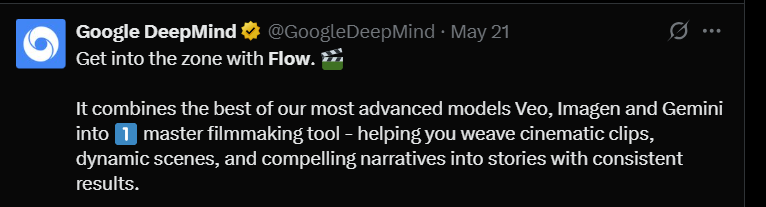
Let’s understand what’s Veo 3, Imagen 4 and Gemini
Veo 3: Google DeepMind’s latest video generation model, capable of producing high-quality videos with native audio (dialogue, ambient sounds) and improved physics, lip-syncing, and prompt adherence.
Imagen 4: Generates high-fidelity images (up to 2K resolution) for assets like characters or settings, with enhanced detail for textures like fabrics or water.
Gemini: Facilitates intuitive prompting, allowing users to describe scenes in everyday language and refine narratives.
Flow AI represents the evolution of Google’s earlier VideoFX experiment and is now available in the U.S. for subscribers to Google AI Pro
The UI walkthrough and onboarding tips suggest Flow is more than a simple text-to-video tool—it combines multiple generation methods into a modular pipeline, with project-based workflows and visual editing capabilities.
Flow AI by Google offers features like:
Camera Controls: Adjust angles, motion, and perspectives.
Scenebuilder: Edit or extend shots for seamless transitions and consistent characters.
Asset Management: Organize imported or generated assets (e.g., characters, locations).
Flow TV: A showcase of community-created clips with visible prompts for learning.
It’s available to Google AI Pro ($19.99/month, 100 generations/month, Veo 2) and Google AI Ultra ($249.99/month, higher limits, early Veo 3 access) subscribers in the U.S., with expansion planned.
Why This Works with Flow
Ease of Use: The natural language prompt is intuitive, leveraging Gemini’s ability to interpret creative ideas without technical jargon.
Creative Control: Camera controls and Scene Builder allow precise direction (e.g., low-to-aerial transition), making it feel like a professional storyboard.
Inspiration via Flow TV: I could browse Flow TV for similar cyberpunk clips, study their prompts, and adapt techniques to refine my vision.
Google Announced flow on May 20, 2025, at Google I/O, Flow is pitched as a tool to “amplify human creativity” for filmmakers and storytellers, not replace them. It evolved from Google’s VideoFX experiment.
Google partnered with filmmakers like Darren Aronofsky, who used Flow for short films like “Freelancers” and “Electric Pink,” showcasing its potential for professional storytelling.
Some filmmakers worry about AI tools like Flow blurring the line between creator and “prompt engineer,” potentially impacting jobs. Google embeds SynthID watermarks to address authorship issues, but legal frameworks for AI-generated content remain unclear.
Junie Lau is a film director and multidisciplinary creative deeply passionate about innovation, viewing AI as a vital collaborator in expanding the boundaries of creative expression. Her work delves into artistic narratives within the hyper-modern era, including themes of virtual identity, digital humanities and digital ontology. Currently, Junie is working on a film titled “Dear Stranger,” which explores the boundless and infinite nature of universal love between a grandmother and grandchild across countless parallel worlds.
The Enjoy the our Tech & startups articles
